2.10 Beat atlas: speed, force and grid
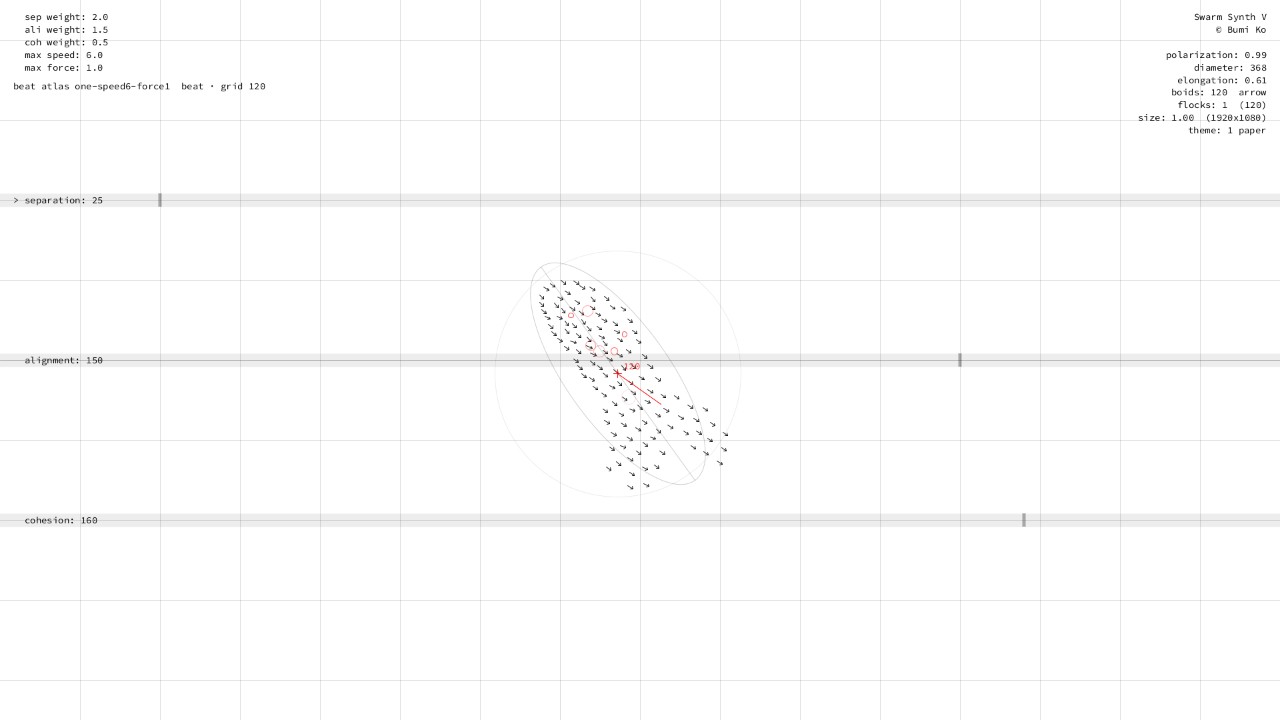
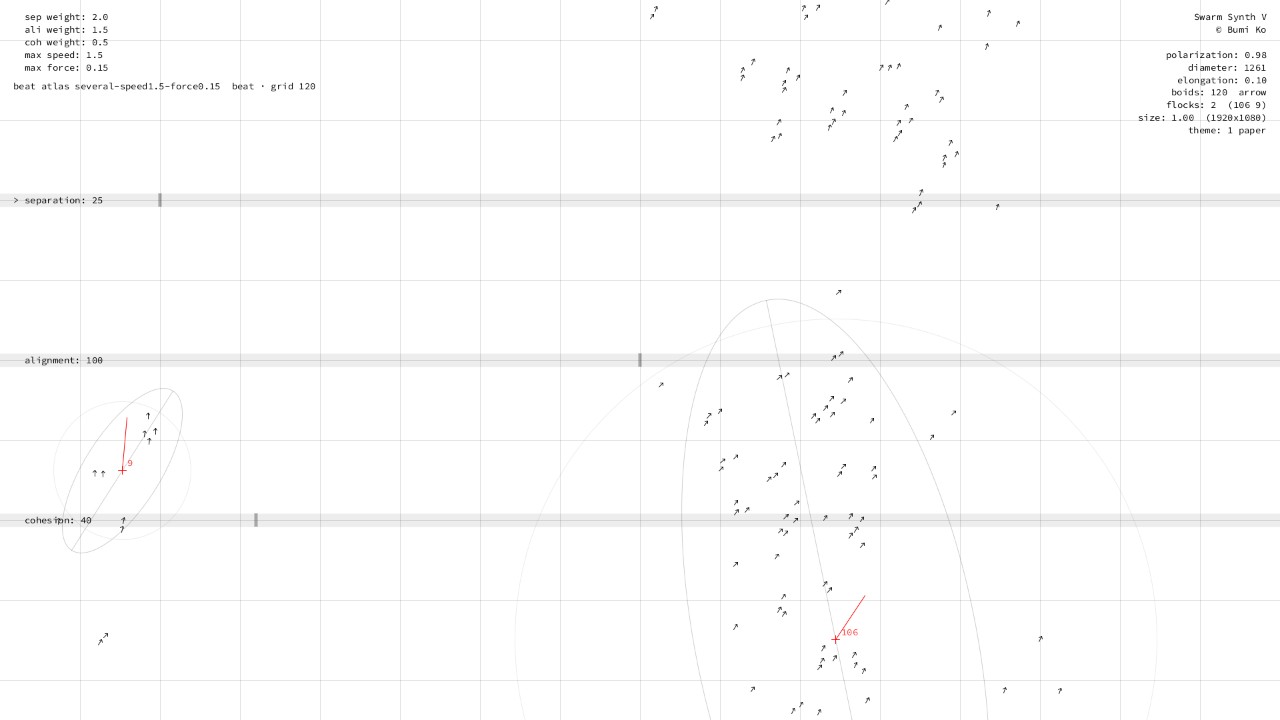
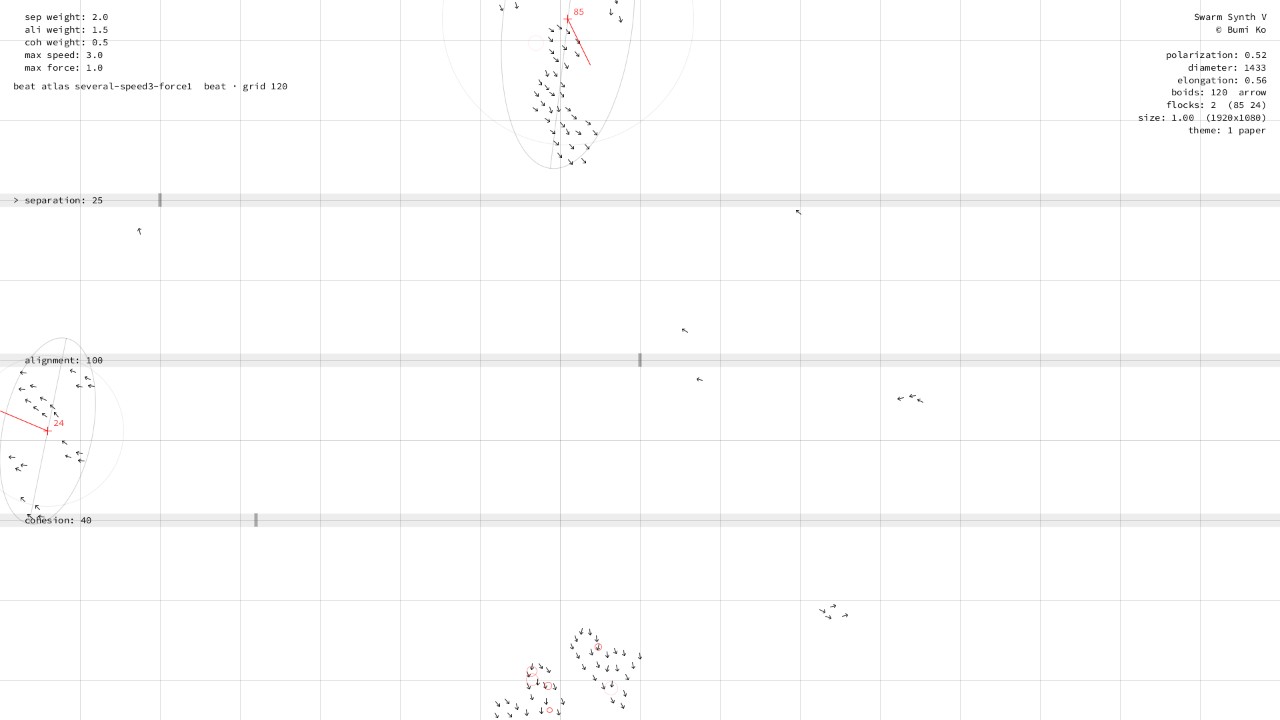
The sound atlas maps the three radii, but the radii only decide whether flocks form; how the beat sounds is decided by how the flocks fly and by the grid. So the beat has its own atlas: the radii are held at two formations that make flocks — one flock (25 / 150 / 160) and several flocks (25 / 100 / 40, about three) — and the instrument plays through speed 1.5 / 3 / 6 (each step doubles the tempo) × max force 0.15 / 1.0, each flight settled for 20 s and measured for 20 s with three seeds, with a 10 s video clip (the beat grid shown) and a still of each. The clips play the beat alone, without the drones and the notes, so that it can be heard.
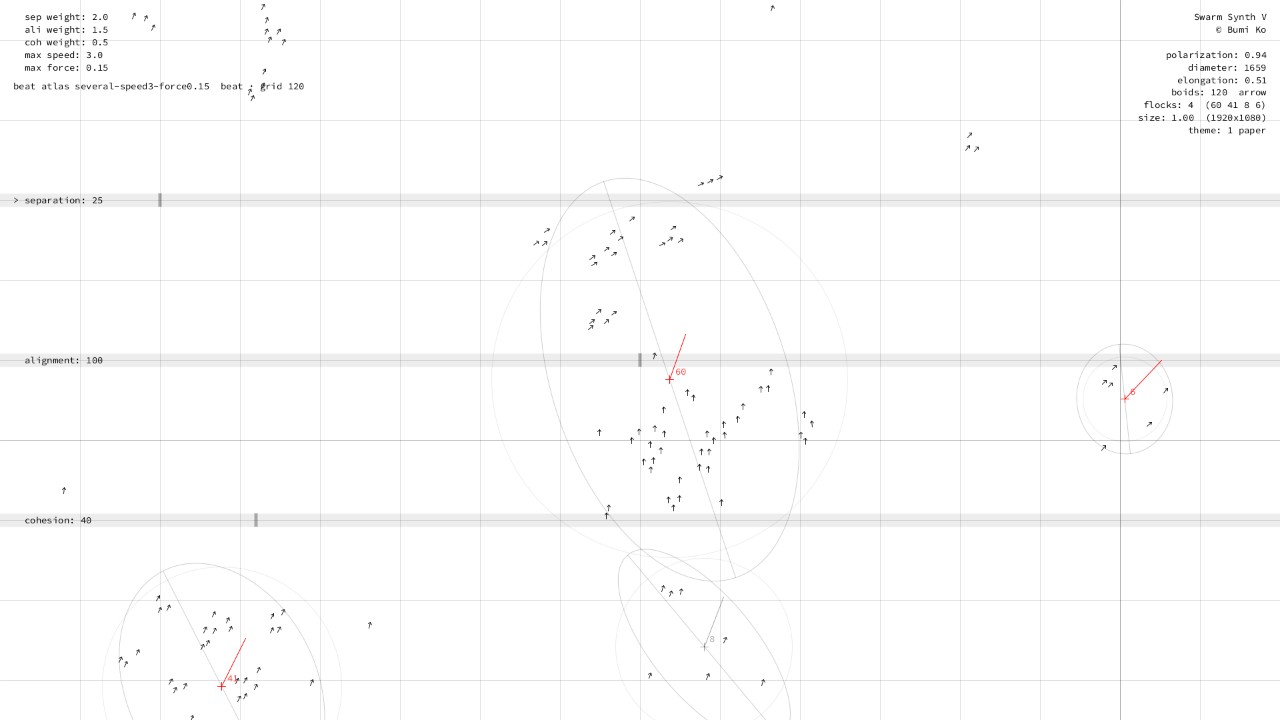
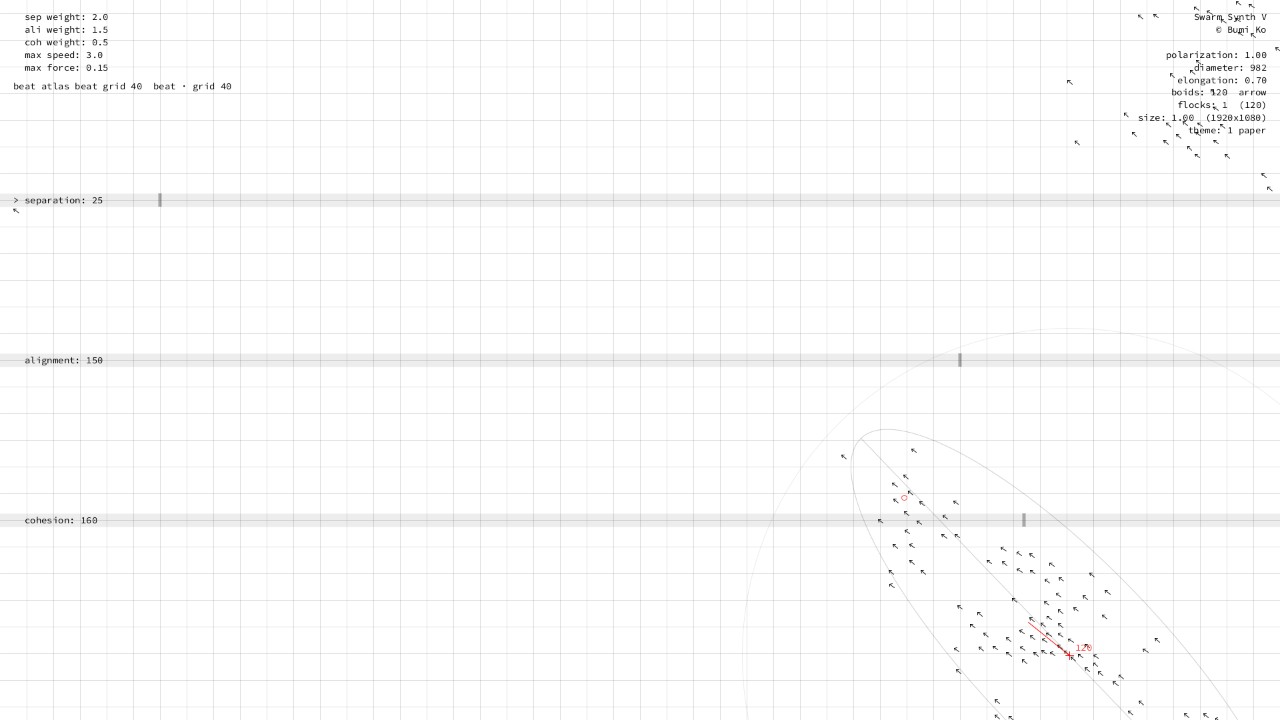
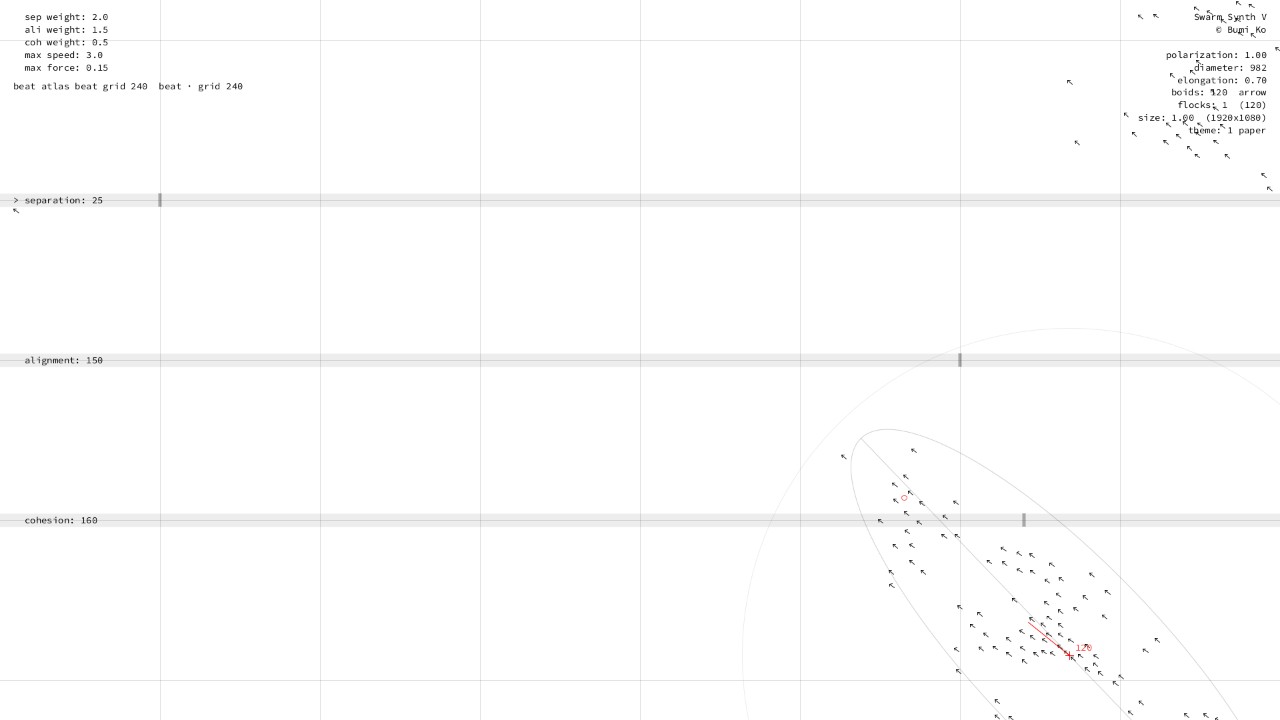
The grid changes nothing about the flight (the beat never touches the flock), so every flight is counted silently on all five grids at once: each grid column below is the same flight. The beat grid replays one flight (one flock, speed 3, force 0.15) audibly on three of them: 40, 120 and 240 px.
Tempo. A flock flying straight along a grid axis at full speed crosses a line every grid / speed steps, so
BPM = 3600 × speed / grid (a main beat is one beat)Real flocks fly a little below top speed and not exactly along an axis, so the measured tempo is a steady fraction of this (efficiency): for one flock, median force 0.15: 0.88, force 1: 0.81. A turning, jittering flock covers less ground.
| speed | grid 40 | grid 60 | grid 80 | grid 120 | grid 240 |
|---|---|---|---|---|---|
| 1.5 | 119 (135) | 79 (90) | 59 (68) | 40 (45) | 19 (23) |
| 3 | 238 (270) | 158 (180) | 118 (135) | 79 (90) | 40 (45) |
| 6 | 514 (540) | 342 (360) | 256 (270) | 171 (180) | 86 (90) |
Measured BPM, one flock, force 0.15; the prediction in brackets.
Steadiness: the share of main-beat intervals within 10% of the one before (same flock). Low max force keeps the flight straight and the beat steady; several flocks are less steady than one, because flocks turn, cross and merge.
| formation | force | speed 1.5 | speed 3 | speed 6 |
|---|---|---|---|---|
| one flock | 0.15 | 0.49 | 0.83 | 0.91 |
| 1 | 0.15 | 0.73 | 0.84 | |
| several flocks | 0.15 | 0.46 | 0.68 | 0.82 |
| 1 | 0.15 | 0.36 | 0.65 |
Steadiness at grid 120 (averaged over three seeds).
- Recipes: a metronome = one flock, force 0.15 (any speed); a groove with breaks = force 1.0 or several flocks; the tempo is then chosen with speed and grid — e.g. ≈ 120 BPM from speed 4.5 at grid 120, or speed 3 at grid 80.
- The extremes leave the range of a beat: a fine grid at high speed runs past 500 BPM, a roll rather than a pulse; a coarse grid at low speed slows to about 20 BPM, single strokes three seconds apart (still steady). The musical range is roughly 40 – 240 BPM.
The tables above give the measurements of every flight on every grid. The clips below are a selection — every flight at grid 120, and one flight on three grids (the beat grid) — since a clip for every combination would be too many.
The beat sounds when a flock crosses a line of the grid. Here the three rules are held at two settings, one flock and several flocks, while speed and max force change. Speed sets the tempo, and with force how steady the flight is: slow flocks wander and the beat becomes a groove, fast flocks fly straight and keep time. Grid 120 px; a flock flying straight along a line at full speed would play 3600 × speed ÷ 120 BPM (in brackets). The clips play the beat alone, without the drones and the notes.
Beat, one flock
Force →
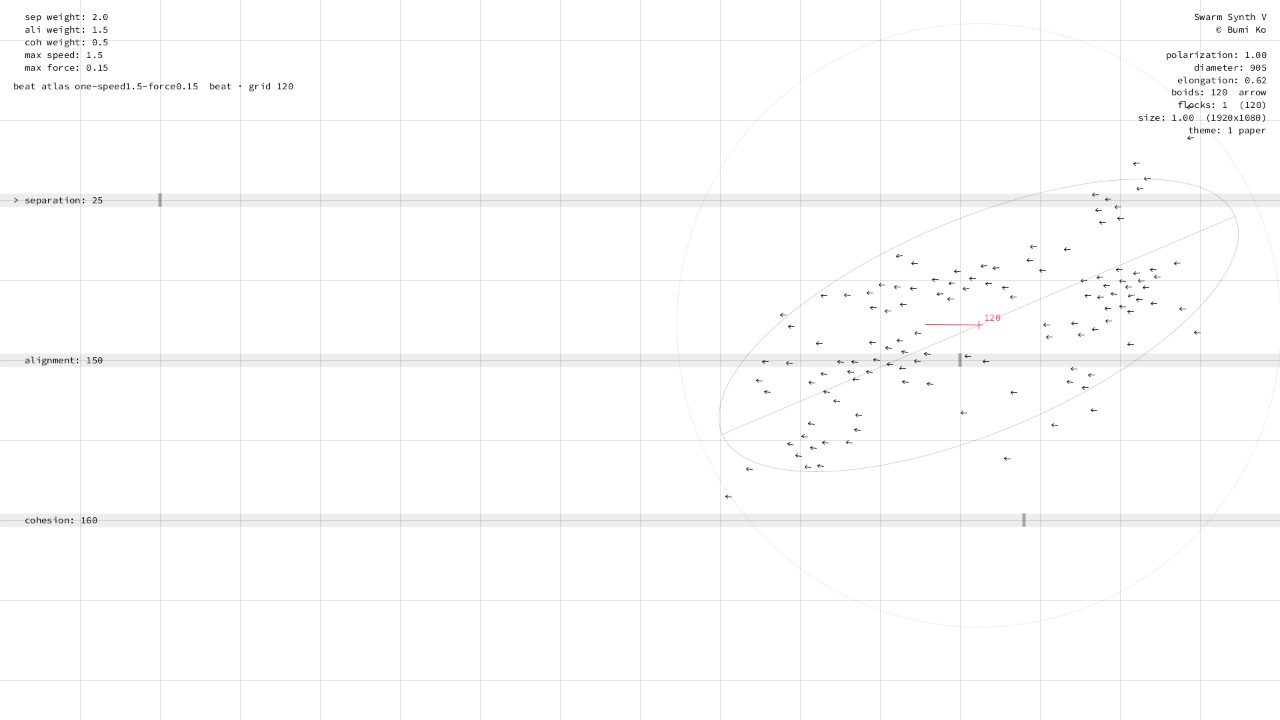
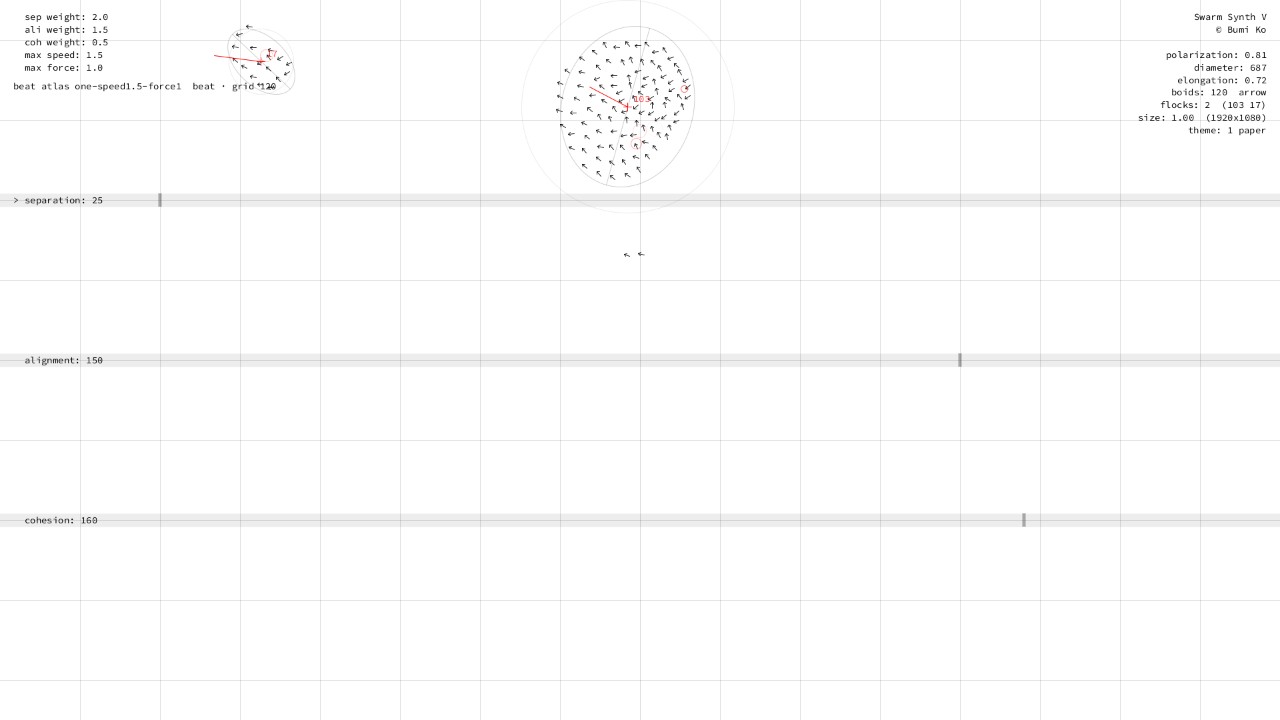

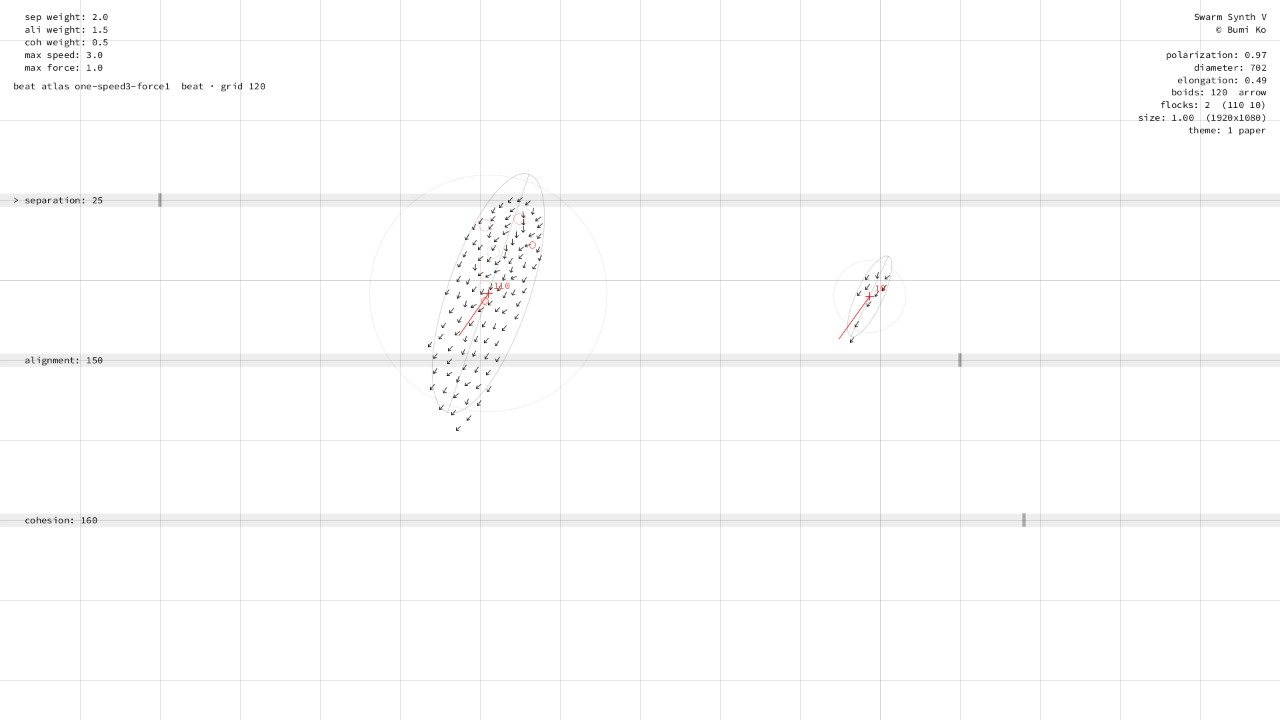
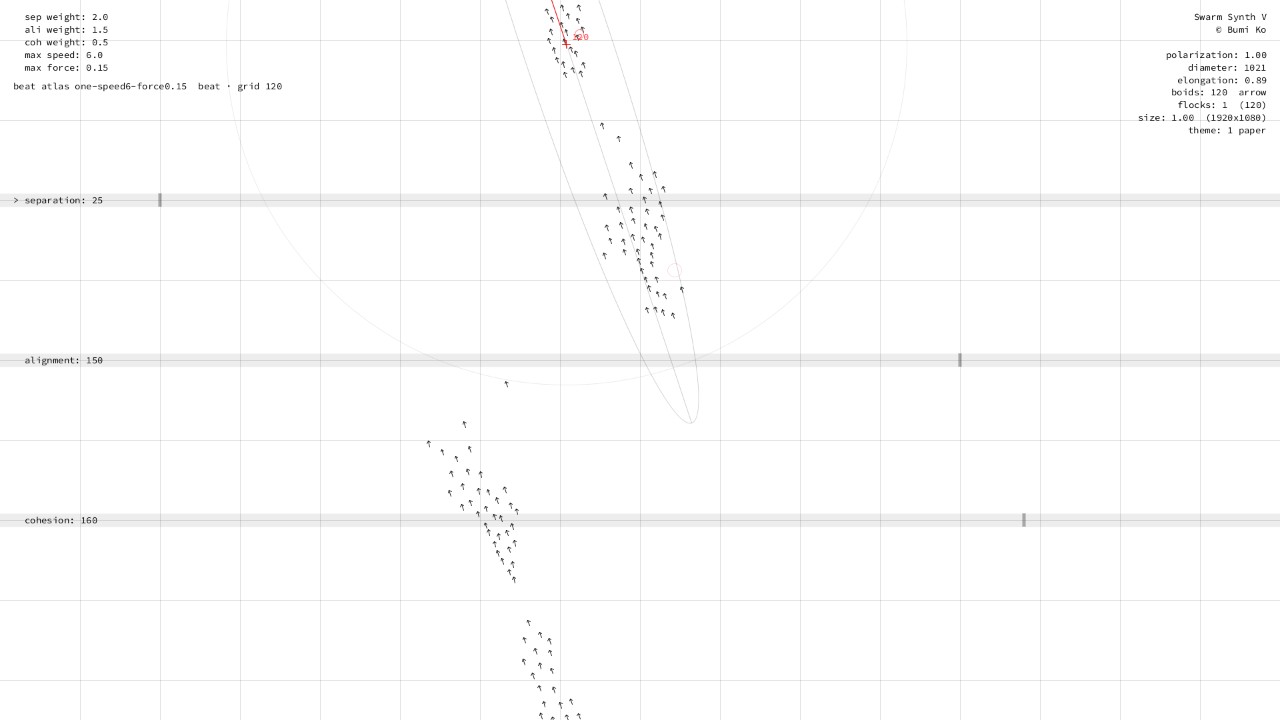
Beat, several flocks
Force →

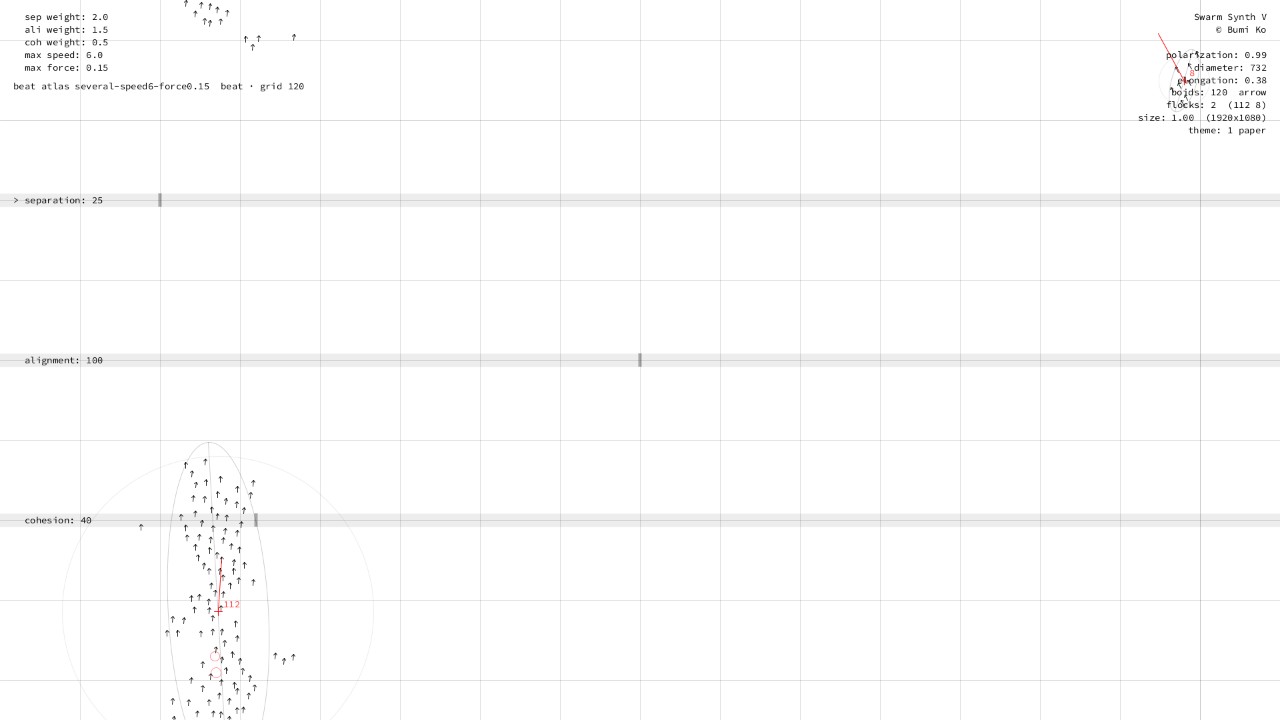
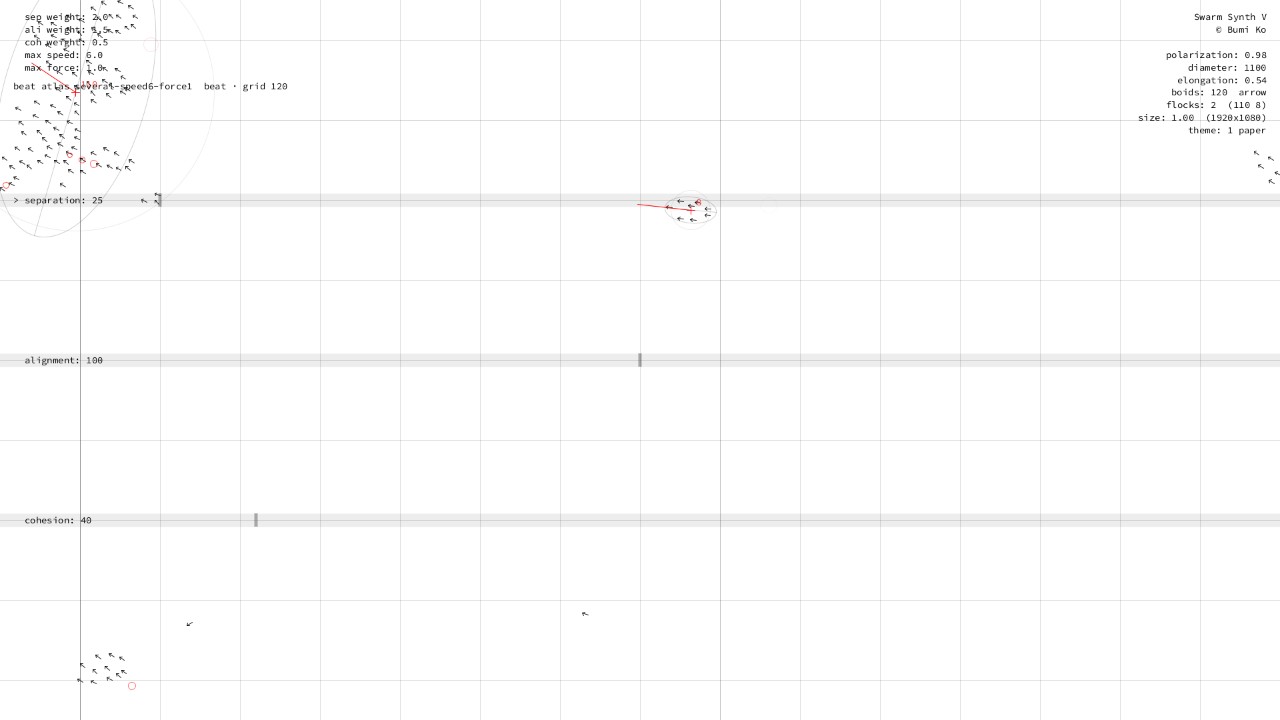
Beat grid
One flight (one flock, speed 3, force 0.15) on three grids, 40, 120 and 240 px: the same flock, only the lines move closer together or further apart. The tempo follows the grid; on the widest grid the flock has time to turn between two lines, and the beat loosens.
2.10.1 In the club edition
The club edition keeps its own clock (2.5.2), so neither the grid nor the flocks' speed sets its tempo. The beat atlas' flights were heard in it too (110 bpm, as in 2.9.4, and like the clips without the drones and the notes); a second line under each still says what the club plays, with its own play button. The beat grid has no such line: on every grid the club would play the same. Nearly every flight plays the drop: the club hears a flock as fast when it flies close to its own top speed, and these flocks do, whatever the top speed is. Here the grid only places the percussion of the second, third and fourth flock: with several flocks, about 7 notes a second on the finest grid (40) and 2 on the coarsest (240); with one flock one a second or less.